.svg)
Includio
Most people have never thought about what happens when a blind person sits down to watch a TV show. There's dialogue, sure. But what about the long, wordless scenes? The meaningful glances between characters? The slow pan across a skyline that sets the mood for an entire episode?
That's where audio description comes in. And it's the reason John Harley built Adrenaline Studios into one of the biggest accessibility-focused media companies in Europe.
In the first episode of Access Delivered, John sat down with Jan to talk about how the company started, what makes audio description actually good, and why the demand for accessible media is about to explode.
It Started With a Mic in the Dining Room
John didn't set out to build an accessibility company. He was a voice actor doing localization work, dubbing programs into different languages, from a home studio he'd set up in his dining room. A booth and a small desk. That was it.
Then a client asked him to do an audio description. He had no idea what that even meant.
After some research, he discovered something that surprised him: a huge amount of TV programming already comes with an optional audio description track. When turned on, a narrator describes the visual elements of a show so that blind and partially sighted viewers can follow along. But most content out there? Still not described.
That realization led to three questions that shaped everything Adrenaline Studios became:
Why isn't more content audio described, given how many people would benefit from it? Can the quality of audio description be made better than what currently exists? And if you do get really good at it, how do you build systems that can handle the volume?
John brought in an experienced audio description writer and narrator, and together they recorded a full series for a British broadcaster. From the dining room. It went brilliantly. And from there, the passion turned into a business.
What Makes Audio Description Good?
There are rules for audio description, and they vary by territory. Adrenaline Studios currently works across roughly 17 to 18 languages, so they're constantly learning what works in different markets. But John believes good audio description always starts in the same place: with creative people.
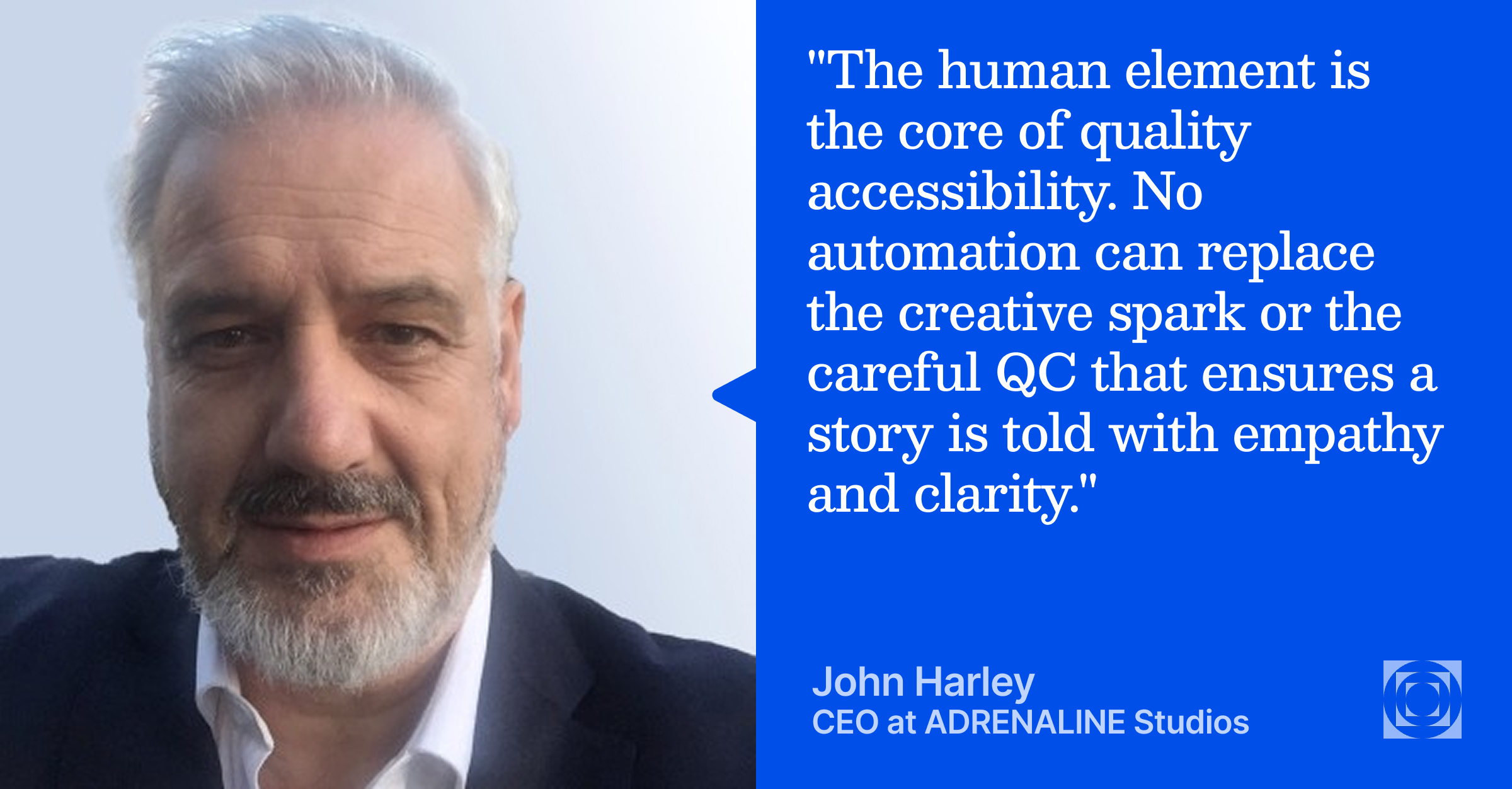
Workflows can be automated. Coordination can be systematized. But the initial spark, the connection between the person writing the description and the person receiving it, cannot be replicated by a machine. It requires a human who understands storytelling, emotion, and timing.
Quality control matters just as much. Every script goes through a human QC stage where someone checks for inconsistencies in character names, storyline errors, and overlaps with existing dialogue. The goal is always the same: make sure the description serves the audience, not just the process.
Care and Love as a Standard
When asked what he'd standardize across the industry if he could change one thing, John's answer was unexpected. It wasn't a file format or a delivery method. It was care and love.
A lot of the technical stuff is already fairly standard. File types, delivery methods, client guidelines about what to describe and what to leave out. That's all manageable.
What John wants to see more of is an understanding that this work opens up entire worlds of entertainment and information for people who would otherwise have zero access. Making a blind person's day a little brighter or a deaf person's evening a little more interesting is not a small thing. And treating the process with that level of respect matters.
When Season Seven Comes Before Season One
One of the best stories from the episode is about a major series where Adrenaline Studios was brought on to audio describe season seven. The problem? Seasons one through six hadn't been described yet.
Almost immediately, John started getting emails from blind viewers. They didn't want to jump into the story six seasons in. They wanted to start from the beginning, like everyone else.
John brought this feedback to the client, who then commissioned audio descriptions for all six previous seasons across 11 languages. It was a mountain of work with tight deadlines, and John wanted the same writers in each language working on the project for consistency.
As the seasons were completed, John kept the people who had written to him updated. When's season two coming? When's season three? There was a real back-and-forth, and it highlighted something important: the audience for audio description is engaged, passionate, and paying attention.
Pushing the Creative Boundaries
Another standout moment was when John asked a major client for permission to push the creative boundaries on a particular audio description script. The show had intense dramatic content, and he felt the description should match that intensity.
There are guidelines in audio description about how far you go with certain content. Swearing, graphic descriptions, the emotional weight of what you're conveying. John wanted to test those limits, just a little.
The client didn't hesitate. Their response was essentially: do it. Challenge your writers, challenge the audience. A blind viewer watching a challenging program should feel challenged, just like a sighted viewer would. No mollycoddling.
The result was a slightly different experience for the audio description audience compared to the sighted one, but the feeling was the same. And that's the whole point..
Listen to & watch the Full Episode
This article covers the highlights, but the full conversation goes deeper into the realities of building accessible media at scale. Listen to Episode 1 of Access Delivered on LinkedIn:
https://www.linkedin.com/posts/janarmbruster_we-just-launched-access-delivered-an-interview-ugcPost-7429516310885208065-7WK5?

.png)