.svg)

Includio
Susanna Laurin on the European Accessibility Act, EN 301 549, and What Broadcasters Need to Know
In this episode of Access Delivered, we sit down with Susanna Laurin, Managing Director and Chair of the Funka Foundation. Susanna chairs the technical body that developed EN 301 549, the standard the European Accessibility Act relies on for conformance. She co-founded EAAP, advises the European Commission directly, and has been shaping accessibility policy for over 20 years.
How it all started
Susanna's path into accessibility began with a background in politics and policy, and a frustration she couldn't shake. Growing up in Sweden, a country that prides itself on strong social legislation, she could still see that people with disabilities weren't getting the same opportunities as everyone else. Her parents regularly welcomed disabled friends into their home at weekends, and watching seemingly simple things fail for them left a mark.
"I thought somebody needs to do something about that. So that's where it all started. And then I happened to get the opportunity to at least try to contribute to changing things. And now I just can't stop."
The EAA and EN 301 549: untangling the confusion
One of the most common points of confusion in European accessibility circles is the relationship between the European Accessibility Act (EAA) and the EN 301 549 standard. As Susanna puts it, mixing up laws and standards is "a little bit apples and pears."
Part of the problem, she explains, is that many accessibility experts come from the US and try to read European legislation through an American lens. "It's a completely different thing. You need to kind of put on your EU glasses to understand."
The EAA is the law. It sets out who is responsible, what needs to be accessible, and how enforcement works. Its annexes lay out specific requirements for products and services. Susanna encourages people to read the document itself: "If you're into kind of the digital, I don't think this is too much to ask."
The EN 301 549, along with a handful of other supporting standards, is voluntary. It provides detailed technical specifications, the how behind what the law requires. Following the standard gives you what's known as "presumed conformance": if you meet the standard, you know you're meeting the law.
Common misinterpretations
Susanna flags several areas where people go wrong. The most frequent is confusing the EAA with the Web Accessibility Directive (WAD), which focuses specifically on websites and apps in the public sector. The two laws are entirely different in scope.
The EAA is far more ambitious. It covers a wide range of products and services and, critically, the entire value chain. Manufacturers, distributors, importers, and sellers all carry responsibility. "Maybe I can say, no, I just bought that thing, it's somebody else's problem, but no, you're still responsible if you are the one selling products or services to consumers in the EU."
Another misunderstanding: the EAA is EU legislation, but it applies to any company selling to EU consumers, regardless of where that company is headquartered. A US or Chinese firm selling into the EU is covered.
What the standard means for broadcasters
For broadcasters, the picture has its own complexities. The EAA doesn't directly regulate broadcast content. It focuses on how consumers access media. That means the TV set-top box, the streaming service, and the platforms through which people reach programmes.
The core obligation is straightforward: everything that is seen but not heard needs to be captioned (or "subtitled," as the EU now terms it, meaning same-language captioning, not translation). Everything that is heard but not seen needs to be audio described.
Sign language provision sits within national laws rather than the EAA itself. Public broadcasters, and in many countries private ones too, typically have quotas for sign language interpretation.
The EAA does, however, set requirements around customer support. If a broadcaster provides customer support, instructions, or usage information, these must be delivered accessibly, using more than one sensory channel. Information about how a service works with assistive technology must also be included and made accessible. That applies whether the support is provided by a human or by AI.
The value of working with users
Susanna is clear that legislation alone isn't enough. Real progress comes when organisations work directly with disabled users and try new technology alongside them.
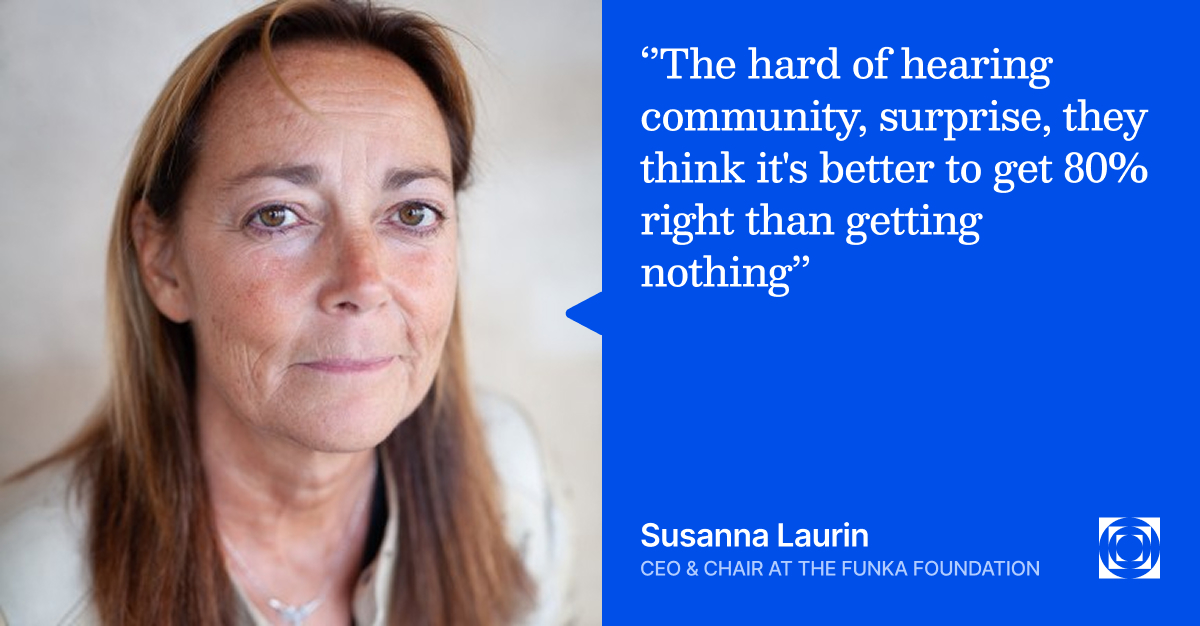
She points to the Nordic experience with auto-captions. People who don't need captions tend to dismiss them. "Oh, that's horrible. It spelled my name wrong. It's absolutely crap." But the hard of hearing community sees it differently: "They think it's better to get 80% right than getting nothing."
That's not an argument for bad captions, Susanna stresses. Quality still matters, and more detail is needed in the standards for people who truly depend on them. But engaging with users can shift perspectives and unlock progress that quotas and percentages alone never will.
Sign language avatars: a game changer on the horizon?
Susanna admits she has long been sceptical of sign language avatars, having seen "so many bad solutions" over the years. The fundamental problem has been that they fall flat, literally. Sign language is a three-dimensional language, and past avatars have failed to capture the depth and proximity to the body that makes it readable.
But something is shifting. The gaming industry has produced sophisticated avatars for years; the technology exists. "If the funding is behind it, I think we now have a possibility to make a real change, which would be really a game changer for sign language users."
The challenge remains that deaf communities are small and scattered across many different sign languages, making investment harder to justify commercially. But the potential is there.
One piece of advice for small broadcasters
Asked what she'd tell a small national broadcaster that wants to get accessibility right but doesn't know where to start, Susanna's answer is direct: focus on the web.
Most broadcasters now operate both traditionally and online, and making a web-streamed programme accessible is significantly easier and less expensive than retrofitting the entire traditional broadcast chain. Starting with the web builds infrastructure and capability. From there, organisations can extend accessibility to traditional broadcasts.
"If you don't have a lot of money, then you will maybe solve one thing but not the other if you're doing the traditional broadcast accessible. And that's a pity, because then you don't serve the vast number of people that could potentially get access if you're doing it on the web."
She acknowledges not everyone has moved from traditional TV to the web, so it won't reach everyone. But the potential reach and the return on investment are far greater when you start digital.
The advantage of separating law and standard
One of the shrewdest points Susanna makes is about the design of the European system itself. Because the law and the standard are separate instruments, the standard can be updated without reopening the legislation, a process that "takes a lot of political effort and takes forever." This means the framework can keep pace with technological advances in captioning, audio description, sign language, and beyond, without needing to change the law each time.
Access Delivered is an interview series by Includio exploring accessibility in media. Follow Includio on LinkedIn for further episodes and resources.

.png)