.svg)

Includio ApS
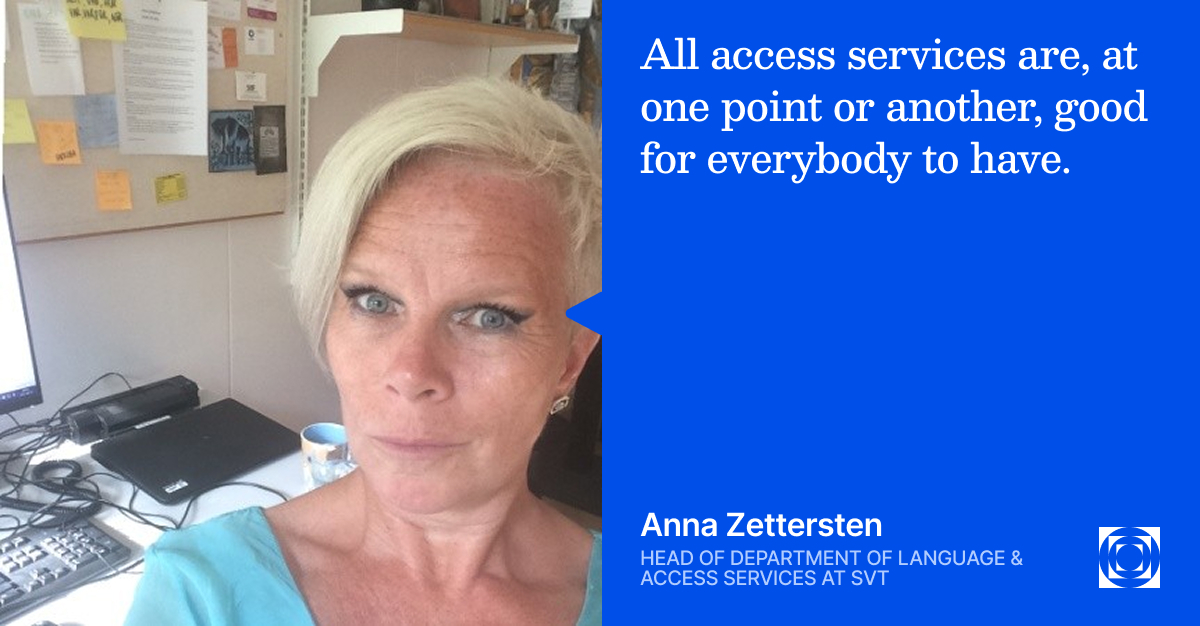
Anna Zettersten on How SVT Delivers Accessibility at Scale: Subtitling, Audio Description, and Clearer Speech
Anna Zettersten is Head of Language and Accessibility at SVT, Sweden's national public broadcaster. Her department covers subtitling, audio description, sign language interpretation, spoken subtitles, and clearer speech. SVT serves over 10 million people and has been pushing accessibility further than most broadcasters in Europe. In this episode of Access Delivered, she walks us through the numbers, the workflows, and the thinking behind it all.
The scale of SVT's accessibility operation
The numbers alone tell a story. SVT publishes around 11,000 hours of Swedish content every year, roughly half of it newly produced. Since 2014, they've had a quota requiring 100% closed captioning on that output. On top of that, SVT purchases about 5,000 hours of foreign programming annually, translating into Swedish from around 9,100 different languages.
Local news adds another 5,000 hours a year across 21 regional editions. Those are subtitled fully automatically, with no human correction unless a viewer or editor flags an error. Live subtitling covers approximately 6,000 hours a year across both broadcast and SVT Play, the streaming service, with a quota target of 90%.
Sign language interpretation and audio description are newer services, with quotas in place for only eight years. This year SVT is delivering around 430 hours of audio description, rising to 470 next year.
Then there are the features that go beyond traditional accessibility categories: spoken subtitles for all open-captioned content, and clearer speech (or enhanced dialogue), which runs to several thousand hours a year and has proved very popular with viewers.
AI-assisted subtitling for local news
When SVT introduced automatic subtitling for its 21 local news editions, it wasn't replacing an existing service. There had been no closed captioning on local news at all. The automated workflow was the way to give audiences something they didn't have before.
The captions appear in the streaming service about half a minute after broadcast. Live broadcast captions for local news aren't available yet, though Anna says it's on the list.
The system is entirely internally developed and built as a chain of small functions rather than a single monolithic process. If something goes wrong, the team can quickly identify where in the chain the problem sits and fix it. Anna is candid that this service relies mainly on the machine, without the same level of human-machine cooperation that SVT's other subtitling workflows have.
How clearer speech and spoken subtitles were born
Both features came out of SVT's internal innovation weeks, held twice a year. All development teams gather for about a week to form cross-functional groups, prototype ideas that aren't in the backlog, and present them. Some get picked up and developed further. Most don't.
"If you invent 100 things, at least maybe 10 will work out," Anna says. Both spoken subtitles and clearer speech came through this process.
Clearer speech in particular has been a standout success. It has won prizes, usage increases every month since its release around four years ago, and SVT can measure exactly how much it's being used. It requires content to be produced in more than stereo, so it doesn't cover everything, but it already runs to several thousand hours a year.
Choosing what gets audio described
A small group of three or four people at SVT meets a few times a year to decide which titles will receive audio description and sign language interpretation in the coming months. The guidelines are straightforward: audio description goes to visually told stories, so drama and documentaries, while sign language interpretation suits dialogue-heavy content like news and debates.
The audience plays an active role. Viewer organisations gather feedback from their members and feed it back to SVT. "It's like a co-work with the audience," Anna says. "We want more of this, we want less of that."
A notable milestone: during the most recent Olympic Games, SVT live audio described sports for the first time, covering seven skiing competitions. Sweden took a lot of gold medals, so it turned out to be the right choice.
The audio description workflow itself is classical. A writer scripts the descriptions, a voice artist records them with a sound engineer, and the result is mixed as a separate audio track. On SVT Play, viewers can combine audio description with subtitling and clearer speech simultaneously, mixing features to suit their needs.
What the viewer surveys revealed
SVT runs viewer surveys four times a year on its live subtitling, which uses three approaches: traditional manual subtitling, AI-supported subtitling (where a human corrects the ASR output), and fully automated subtitling. A single programme can involve all three.
One finding surprised the team. Punctuation, something the language-oriented professionals at SVT care deeply about, turned out to matter much less to viewers than expected. "The audience is not sensible to let out interpunctuation," Anna notes. "That was quite a surprise."
What does bother viewers is synchronisation. A small delay is tolerable, but legacy system issues sometimes cause subtitles to appear before the speech on certain platforms, which audiences find very irritating. Word loss and incorrect words are the other main complaints.
Scores have improved between the November and March surveys, but SVT isn't satisfied yet. They're pushing to improve further ahead of the next survey in May.
Accessibility beyond the core audience
Anna makes an important observation about who actually uses these features. Older viewers may develop hearing impairment or sight loss, but younger viewers are increasingly insistent on subtitles too. "I have subtitles on everything, they say. I want it to be subtitled, otherwise they just click it away and don't watch."
Audio description usage also extends well beyond the visually impaired audience. Access services, Anna argues, are good for everybody to have at one point or another.
Access Delivered is an interview series by Includio exploring accessibility in media. Follow Includio on LinkedIn so you don't miss the next episode.

.png)