.svg)

Co-founder @Includio

Audio Description and Subtitling Requirements in Europe: What Each Country Actually Requires
If you distribute content in more than one European country, you already know that access service requirements are not the same everywhere. Each country has its own regulator, its own quotas, and its own interpretation of the AVMSD and EAA.
This is a reference guide. It covers what broadcasters, streaming platforms, and distributors actually have to provide in each major European market. SDH (subtitles for the deaf and hard-of-hearing), audio description, and sign language — who requires what, how much, and who enforces it.
We update this page as regulations change. Last updated: March 2026.
United Kingdom
Regulator: Ofcom
Legislation: Communications Act 2003, Media Act 2024
Applies to: All licensed broadcast channels meeting audience share thresholds; VoD services under new Media Act rules
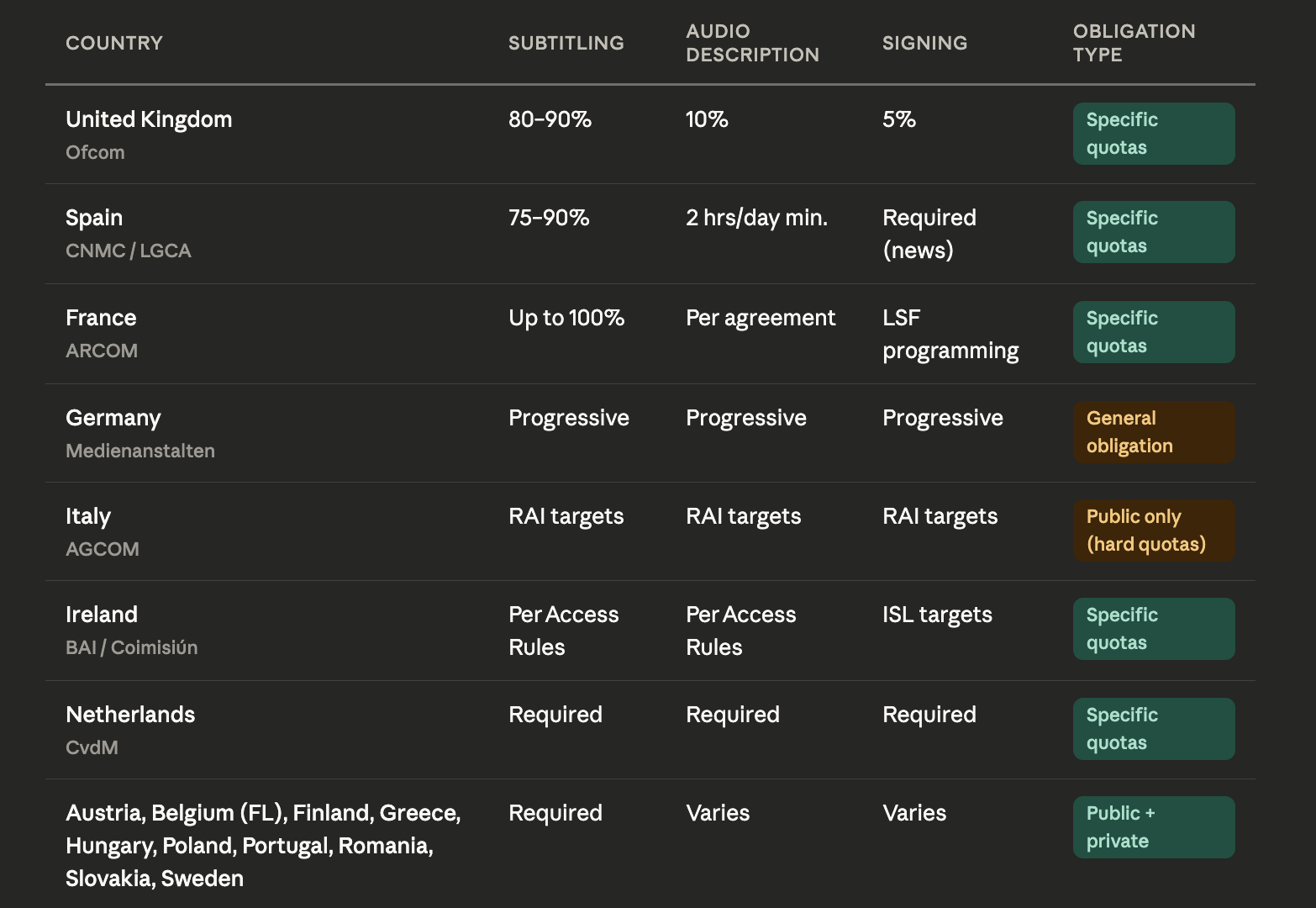
Broadcast TV quotas (10-year targets):
- Subtitling: 80% of programming (90% for BBC, ITV, Channel 4)
- Audio description: 10% of programming
- Signing: 5% of programming
These targets are prescribed by the Communications Act and rise from a low starting level over ten years for each channel. Ofcom publishes annual compliance reports showing how each channel performs against its specific quota.
VoD / streaming (from Media Act 2024):
The UK government announced in February 2026 that major streaming services (Netflix, Amazon Prime Video, Disney+, ITVX, etc.) will be required to meet:
- Subtitling: 80% of catalogue
- Audio description: 10% of catalogue
- Signing: 5% of catalogue
Ofcom will draft and enforce the new VoD accessibility code. Maximum fine per breach: £250,000 or 5% of qualifying revenue.
Source: Ofcom Code on Television Access Services
Spain
Regulator: CNMC (Comision Nacional de los Mercados y la Competencia)
Legislation: Ley General de Comunicacion Audiovisual (LGCA), Law 13/2022
Applies to: Linear TV (public and commercial), pay TV, VoD services established in Spain
Linear TV quotas:
- Subtitling: 90% on public channels, 75% on commercial channels
- Audio description: minimum 2 hours per day on public and commercial channels
- Sign language: required for news and certain programming
The 2022 LGCA extended these obligations to pay TV platforms (e.g., Movistar+) and Spanish-established VoD services (e.g., Filmin, Flixole). Services established outside Spain but within the EU (Netflix, Amazon, HBO) fall under their home country's regulation unless specifically targeting Spain, in which case some obligations apply.
Source: LGCA Law 13/2022
France
Regulator: ARCOM (Autorite de regulation de la communication audiovisuelle et numerique)
Legislation: Law of 30 September 1986 (as amended), transposition of AVMSD
Applies to: All TV channels, on-demand services with annual revenue exceeding EUR 1 million in France
TV channels:
- Subtitling: up to 100% for channels with audience share above 2.5%. Specific quotas set per channel in individual agreements with ARCOM.
- Audio description: obligations set per channel agreement. Public service channels (France 2, France 3, France 5) have the highest requirements.
- Sign language: some children's channels have replaced subtitling obligations with French Sign Language (LSF) programming.
VoD / on-demand:
Since June 2025, ARCOM enforces accessibility obligations for all publishers and distributors of audiovisual media services under the EAA. This includes platforms like TF1+, France.tv, M6+, Arte.tv, Netflix, Amazon Prime Video, and Disney+ (when accessed via French platforms). Obligations cover accessible websites, mobile apps, EPGs, and transmission of access services (SDH, AD, sign language) where they exist.
Source: ARCOM — rights of disabled people
Germany
Regulator: Die Medienanstalten
Legislation: Medienstaatsvertrag (State Media Treaty, MStV), in force since November 2020
Applies to: Public and private broadcasters, online providers with more than 20,000 followers/users
Germany's approach is less prescriptive than the UK or Spain. The Medienstaatsvertrag requires providers to "gradually increase their offerings in terms of accessibility" but does not set specific percentage quotas. Public broadcasters (ARD, ZDF) must increase accessible programming "within their technical and financial possibilities."
From mid-2025, the MStV requires all online providers to offer accessible content. This applies to streaming platforms, websites, and video-sharing services established in or targeting Germany.
Film funding in Germany increasingly requires accessible versions (SDH + AD) as a condition of support. The guidelines of individual film funding bodies (e.g., FFA, regional film funds) set specific requirements, and producers need confirmation from BAFA (Federal Office for Economic Affairs and Export Control) that accessible versions have been produced.
Source: Medienstaatsvertrag
Italy
Regulator: AGCOM (Autorita per le Garanzie nelle Comunicazioni)
Legislation: Legislative Decree 208/2021 (transposition of AVMSD)
Applies to: Public broadcasters (mandatory), private broadcasters (under AGCOM direction)
Italy's obligations have historically applied primarily to public broadcaster RAI, with private broadcasters subject to AGCOM guidance rather than hard quotas. RAI has specific subtitling and AD targets set in its public service contract. AGCOM has the authority to set accessibility requirements for private broadcasters and on-demand services but enforcement has been less structured than in the UK or Spain.
The EAA transposition into Italian law adds new obligations for services providing access to audiovisual media, covering platform accessibility (interfaces, EPGs, user controls) from June 2025.
Source: FRA analysis of Italian media accessibility
EU-wide: which countries require what
The EU Fundamental Rights Agency (FRA) mapped media accessibility obligations across all member states. The picture is uneven:
Countries requiring access services from both public and private broadcasters:
Austria, Belgium (Flemish Community), Cyprus, Finland, France, Germany, Greece, Hungary, Ireland, Netherlands, Poland, Portugal, Romania, Slovakia, Spain, Sweden.
Countries requiring access services from public broadcasters only:
Bulgaria, Croatia, Czech Republic, Denmark, Italy, Slovenia.
Countries with no specific legal requirement (as of last FRA assessment):
Estonia, Latvia, Lithuania, Luxembourg, Malta.
Note: this FRA data predates the EAA coming into force in June 2025. The EAA adds platform-level accessibility obligations across all 27 member states, but it does not mandate specific content-level access services (SDH percentages, AD hours). Those remain set by national regulators under the AVMSD.
Source: FRA - legal accessibility standards for public and private audiovisual media
The two laws that matter: AVMSD and EAA
There is a lot of confusion about what the EAA requires versus what the AVMSD requires. Here is the short version:
AVMSD (Audiovisual Media Services Directive, 2018/1808):
Requires member states to ensure audiovisual media services are made "continuously and progressively more accessible" to persons with disabilities. Each country decides how to implement this: what quotas to set, which services are covered, how quickly to scale up. This is where the subtitling percentages, AD hours, and signing requirements come from.
EAA (European Accessibility Act, Directive 2019/882):
Covers the platforms and interfaces used to access audiovisual media, not the content itself. Requires that websites, apps, EPGs, set-top-box applications, and connected TV services are accessible. Also requires user controls for captions and audio description to be provided at the same level of prominence as primary media controls (EN 301 549, clause 7.3).
The EAA does not say "all content must have SDH and AD." It says the mechanisms for accessing and controlling access services must be accessible. The content obligations come from the AVMSD and national law.
This distinction matters if you are a distributor or platform operator. You may need to comply with the EAA for your interface and the AVMSD (via national law) for the content you carry.
Source: EAA Directive 2019/882, Article 2(2)(b) and Annex I Section IV(b), AVMSD Directive 2018/1808, Article 7
What this means if you distribute across territories
Every territory is different. If you sell content into Spain, the UK, and France, you are dealing with three different regulators, three different quota structures, and three different sets of technical requirements.
What stays consistent: EN 301 549 is the technical standard across the EU for how access services are delivered (timing, synchronisation, user controls). WCAG 2.1 AA is incorporated into EN 301 549 for web and app interfaces.
What varies: how much content needs SDH, how many hours of AD are required, whether the obligation falls on the broadcaster, the platform, or both, and how strictly it is enforced.
If you need help figuring out what applies to your specific distribution footprint, get in touch.

.png)